
 Sarah Kim
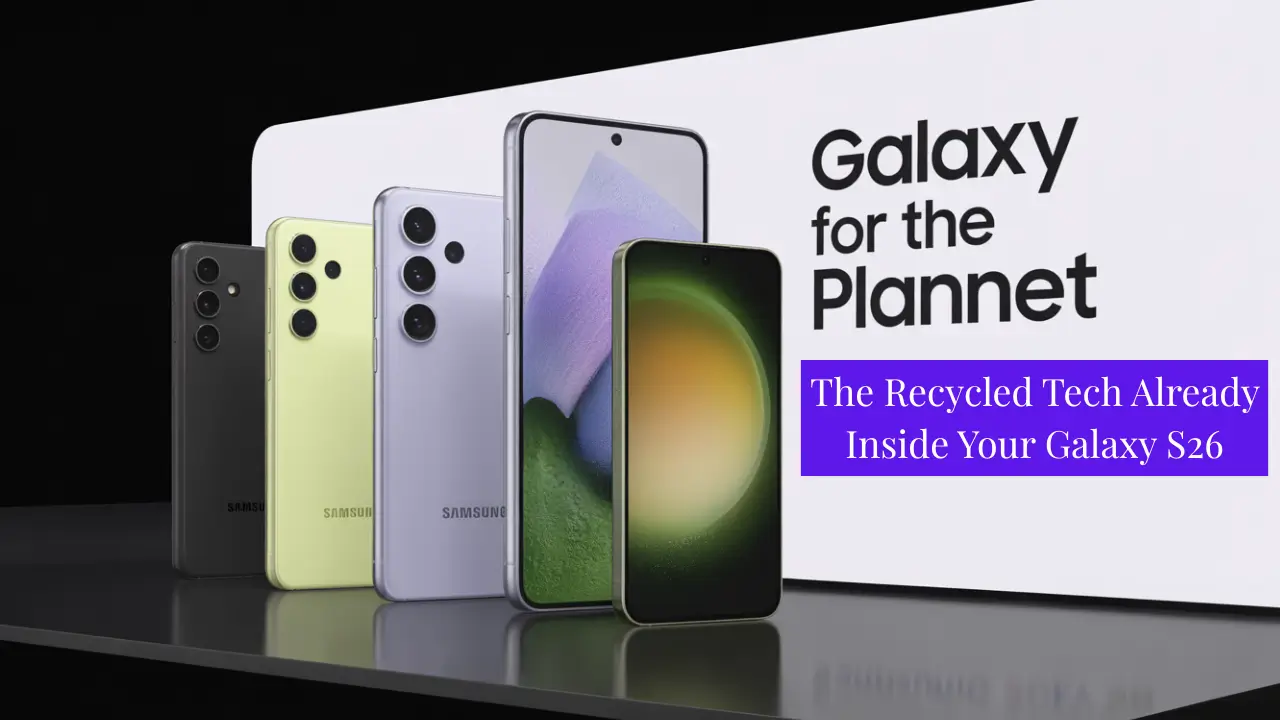
Not all of the Galaxy S26’s most important specs appear on its spec sheet. Know that buried inside its aluminum frame, battery cells, and circuit components are materials that once lived inside a discarded Galaxy device. Samsung has now applied 10 types of recycled materials across Galaxy products a milestone confirmed under its Galaxy for the Planet 2025 initiative, which the company officially declared complete on February 24, 2026.
Cobalt That Came Back
The Galaxy S26’s battery carries a quiet legacy. Insiders suggest the phone continues Samsung’s Circular Battery Supply Chain practice, first introduced in the Galaxy S25, which recovers cobalt from retired Galaxy devices and factory-discard batteries. The Galaxy S25 became the first Galaxy device to use recycled cobalt a minimum of 50% of the cobalt in its battery cells and that pipeline now feeds the S26 series as well.
Recycled Aluminum, Galaxy S26 Recycled Materials in the Frame
Sources say the Armor Aluminum 2 frame used in the Galaxy S26 Ultra is not just stronger than its titanium predecessor it also carries recycled aluminum content. The Galaxy S25’s armor aluminum frame became the first ever to include recycled material in that component, and Samsung has confirmed this practice continues and expands across the S26 line. The switch from titanium also improves heat dissipation practical for users running intensive AI tasks or 4K video.
What’s Inside the Recycled Mix
Samsung has not disclosed the exact percentage of each material per component in the Galaxy S26, but confirmed recycled materials now span:
- Recycled plastics (including ocean-bound plastics and discarded fishing nets)
- Recycled cobalt and lithium (via Circular Battery Supply Chain)
- Recycled aluminum (in frame and structural parts)
- Recycled rare earth elements — neodymium and others
- Recycled steel, copper, gold, and tantalum in internal components
Packaging Goes Fully Clean
The box your Galaxy S26 arrived in contains zero single-use plastic — not by accident, but by design. Samsung eliminated single-use plastics from all mobile packaging as part of its Galaxy for the Planet 2025 targets, replacing them with paper-based and recycled alternatives. Reports suggest some limited plastic sealing labels may still exist in select markets due to local regulations.
Samsung e-waste and the Self-Repair Push
Reducing Samsung e-waste has become a two-sided strategy. On the production end, Circular Supply Chain recovers materials before they reach landfills. On the consumer end, Samsung’s Self-Repair program lets users fix their own devices — extending product life and keeping old phones out of the bin. Not publicly disclosed: the exact volume of materials recovered globally via these programs each year.
Zero Waste to Landfill: The Factory Side
It is not just the phone that went green. All 10 qualifying Samsung mobile manufacturing sites worldwide — including facilities in India, Vietnam, Korea, Brazil, and Türkiye — have achieved Platinum Zero Waste to Landfill certification under UL Solutions standards, meaning a 100% landfill diversion rate. This certification applies to sites where the Galaxy S26 is manufactured.
Galaxy for the Planet 2025 Goals: All Four Met
Samsung confirmed on February 24, 2026, that it has achieved all four of the original Galaxy for the Planet 2025 sustainability goals, which it set back in 2021. These were:
- ✅ Incorporate recycled materials in all new mobile products
- ✅ Eliminate single-use plastics from mobile packaging
- ✅ Achieve near-zero standby power in mobile chargers (now below 0.005W)
- ✅ Achieve Zero Waste to Landfill at all qualifying manufacturing sites
New 2030 Goals: Water and Biodiversity Enter the Picture
TM Roh, CEO of Samsung’s Device eXperience Division, stated: “Sustainability is central to how we operate and innovate.” The company’s new 2030 targets go beyond materials:
- Circularity: At least one recycled material in every module of every Galaxy mobile product
- Water: Return 110% of water consumed at mobile operations and earn AWS Platinum certification
- Biodiversity: Conserve ecosystems equivalent to the full footprint of Samsung’s global mobile operations
What Galaxy S26 Buyers Are Actually Getting
Reports suggest that 62% of smartphone buyers now consider environmental impact when choosing a device. The Galaxy S26’s sustainability credentials recycled cobalt battery, armor aluminum frame, 100% recycled paper packaging, and Self-Repair support give it a measurable green advantage in a premium market where Apple and Google both compete on eco-friendly narratives.
Renewables Next
Samsung’s renewable energy target is set for 2027: 100% renewable energy across all global DX operations. Not publicly disclosed: the current percentage of renewable energy powering Galaxy S26 production lines. The company’s Galaxy for the Planet progress page is the only confirmed public source for annual updates.



GIPHY App Key not set. Please check settings